close
Choose Your Site
Global
Social Media
Views: 0 Author: Site Editor Publish Time: 2026-07-13 Origin: Site


Excessive radiant heat in under-hood or industrial environments leads to rapid component failure. It creates severe safety hazards and slashes operational efficiency. Engineers and mechanics constantly battle these extreme thermal loads. Traditional fiberglass wraps often fall short in these harsh conditions. We are now seeing a massive shift toward extruded volcanic rock solutions. You need an objective, engineering-focused framework for evaluating basalt fiber tape. This guide cuts through flashy marketing claims. We will ignore misleading "titanium" naming conventions. Instead, we focus on hard structural limits and application realities. You will also learn how to vet suppliers properly. Whether you handle automotive upgrades or heavy industrial machinery, this breakdown ensures you choose the right thermal barrier.
Thermal Superiority: Basalt fiber operates effectively at continuous temperatures of 1,500°F (815°C)—significantly higher than standard E-glass fiberglass.
Risk Mitigation: Improper wrapping can accelerate pipe corrosion; pairing basalt wrap with appropriate metallurgy (like stainless steel) and sealing protocols is non-negotiable.
Marketing Reality: Many "titanium" exhaust wraps are actually proprietary treatments applied to woven basalt; evaluate by technical spec sheets, not branding.
Sourcing Criteria: Industrial and OEM buyers must prioritize weave density, binder composition, and dimensional consistency over baseline price per roll.
Standard fiberglass breaks down quickly in extreme environments. Baseline materials like E-glass typically degrade around 1,000°F to 1,200°F. Once they hit this thermal threshold, severe crystallization occurs. The fibers become highly embrittled and shatter under normal engine vibration. You need a much tougher material for heavy-duty exhaust heat insulation.
Extruded volcanic rock offers the perfect alternative. Manufacturers melt crushed basalt rock and extrude it into continuous filaments. This creates a remarkably resilient material. It boasts natural resistance to severe thermal shock. It also withstands intense vibration degradation far better than standard composite materials. Chemical exposure from oil or fuel spills rarely degrades its structural integrity.
You have likely seen products marketed as "titanium" wraps. This causes massive industry confusion. These wraps rarely contain actual titanium metal. Instead, they are high-grade basalt fibers. Manufacturers apply specialized coatings to these fibers. These proprietary treatments increase handling comfort and durability. Always check the technical spec sheets rather than trusting flashy branding. True performance comes from the underlying volcanic rock structure.
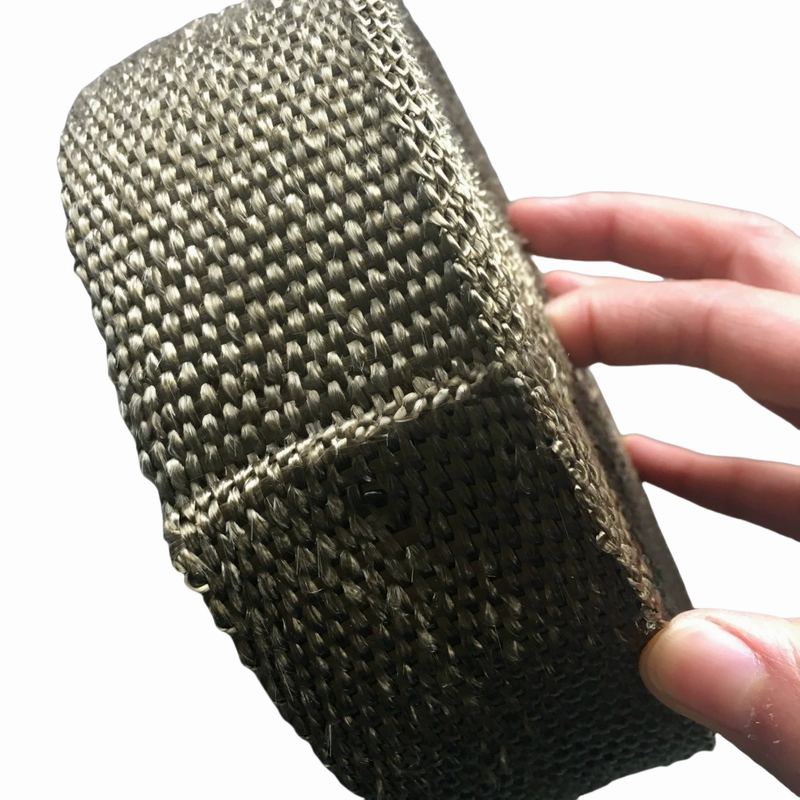
Buyers must carefully evaluate manufacturer data sheets. You should always look at continuous operating temperatures. High-quality, durable basalt fiber tape generally sustains around 1,500°F continuously. Many brands advertise misleading peak or intermittent flash ratings above 2,000°F. Do not rely on peak ratings for everyday operations. Flash ratings only indicate what the material survives for a few seconds before failing.
Tensile strength and flexibility dictate long-term longevity. You must examine how the wrap maintains structural integrity after repeated thermal cycling. Engines heat up and cool down constantly. Poor-quality fibers turn brittle and flake off under these stresses. High-quality basalt retains its physical flexibility over time.
Weave density and material thickness play huge roles in thermal conductivity. A standard thickness of 1/16" combined with a tight weave creates a powerful barrier. It lowers thermal conductivity significantly. Better heat retention inside the exhaust system improves gas scavenging. Hot exhaust gases move faster. This pulls spent gases out of the combustion chamber more efficiently.
Performance Metric | Standard E-Glass Fiberglass | Basalt Fiber Wrap |
|---|---|---|
Continuous Temp Rating | 1,000°F - 1,200°F | 1,500°F |
Peak Flash Rating | ~1,500°F | 2,000°F+ |
Vibration Resistance | Moderate (Prone to embrittlement) | High (Retains flexibility) |
Chemical Tolerance | Susceptible to fuel/oil degradation | Highly resistant to chemicals |
Many automotive forums host fierce debates about wrapping pipes. A common claim states wraps simply destroy exhaust pipes. We must acknowledge this skepticism openly. It contains a strong grain of truth based on the physics of failure.
Trapping heat changes the tempering of thin-walled mild steel. The metal absorbs significantly more heat than it normally would in open air. High vibration compounds this metallurgical issue. This combination easily leads to severe metal fatigue. You will often see cracking at the weld joints over time.
Moisture presents another major operational threat. The porous nature of woven wraps retains water easily. When the system remains inactive, this retained water causes rapid oxidation. Rust quickly eats through mild steel pipes from the outside in.
You can prevent these failures using evidence-based solutions. Apply wraps strictly on 304 or 316 stainless steel. Cast iron and thick-wall headers also handle the trapped heat well. You must also utilize high-temperature silicone coating sprays. These sprays seal the wrap against moisture and fluid ingress. They prevent water from soaking into the fibers while the vehicle sits inactive.
Proper installation dictates how well the barrier performs. The industry constantly debates wet versus dry installation methods. Wetting basalt fiber reduces airborne particulates significantly. This keeps you safer during handling. It also allows for a tighter, more conforming stretch around complex pipe bends. A tighter wrap ensures maximum insulation efficiency.
You must follow strict overlap tolerances during application.
Start at the exhaust port side and work downward toward the collector.
Maintain a strict 1/4-inch overlap as you wrap the pipe sequentially.
Secure the ends tightly using appropriate hardware to prevent unraveling.
Over-wrapping causes localized heat sinks. These extreme hot spots can damage the underlying pipe severely. Under-wrapping allows thermal leaks, defeating the entire purpose of the automotive header wrap.
Securing the material properly prevents catastrophic failure. Never use standard hose clamps or plastic zip ties. You must use stainless steel locking ties. They withstand the extreme heat cycles flawlessly. Once installed, the system undergoes an initial "smoke-off" curing phase. Non-structural manufacturing binders burn away safely. This process produces smoke for a short period. Run the engine in a well-ventilated area until the smoking stops completely.
Procuring material at an industrial scale requires careful vetting. You must look for strict consistency at scale. Evaluate your industrial supplier based on batch-to-batch color consistency. Edge fraying resistance indicates high manufacturing quality. Poorly woven edges unravel quickly during rigorous application.
Customization capabilities matter immensely in industrial settings. Sourcing OEM basalt fiber in precise widths saves massive amounts of installation time. Requesting 1", 2", or 4" widths matches specific pipe diameters perfectly. This minimizes the need for complex, overlap-heavy installations on tight pipe bends.
Compliance and documentation prove supplier credibility immediately.
Request transparent Material Safety Data Sheets (MSDS) for all product lines.
Confirm the absolute absence of asbestos or harmful ceramic fibers.
Verify actual continuous thermal limits through third-party lab testing reports.
Audit manufacturing binder compositions to ensure strict environmental safety.
A reliable partner readily provides this technical documentation. Avoid vendors who rely solely on marketing claims instead of verifiable engineering data.
Implementing an advanced thermal barrier requires careful material selection and correct application. Basalt fiber clearly outperforms traditional fiberglass options across the board. It acts as a superior high-temperature shield when matched with proper metallurgy. Remember to pair it exclusively with robust materials like stainless steel or cast iron. Proper installation techniques guarantee long-term performance.
Take action today to optimize your thermal management systems. First, audit your current exhaust temperatures to determine your exact thermal load. Next, inspect your pipe material to ensure it can handle increased heat retention safely. Finally, request technical data sheets from prospective suppliers to verify all claims before placing bulk orders.
A: Yes, wetting is highly recommended. While basalt is naturally less itchy and abrasive than standard fiberglass, dampening the material significantly reduces airborne particulates. This makes handling much safer. More importantly, water improves the material's pliability. This allows you to pull the tape tighter around complex bends, resulting in a cleaner, more effective barrier.
A: The primary difference lies in thermal capacity and durability. Basalt wrap offers a continuous operating threshold roughly 300°F to 500°F higher than standard E-glass fiberglass. It easily sustains continuous temperatures of 1,500°F. Additionally, basalt provides far superior resistance to severe vibration degradation and harsh chemical exposures.
A: It often does. Many aftermarket header manufacturers void warranties if you use thermal wraps. Wrapping traps intense heat directly against the metal. This alters the tempering of thin-walled mild steel, risking metal fatigue and cracked welds over time. Always check your specific manufacturer's warranty policies before applying any wrap.
A: Lifespan heavily depends on environmental exposure. If you frequently encounter road salt, fluid leaks, or off-road water crossings, the material degrades faster. However, in stationary industrial uses or on well-maintained vehicles, properly sealed wraps last several years. Using high-temperature silicone sprays dramatically extends this lifespan by preventing moisture ingress.